



Alone-Time Behavior•8 min read
Barking after you leave is one of the most common complaints owners have — and one of the most commonly misdiagnosed. It has three main causes, and they need completely different responses.
Record the first 20 minutes and the cause becomes obvious. Barking that starts immediately and stays frantic is distress. Barking that starts later with chewing and movement is boredom. Barking that settles in 10–15 minutes is normal and needs no fixing. Never punish it — that makes distress-based barking worse.
Work out which one you’ve got first, because the wrong fix makes some of these worse.
First: find out what’s actually happening
Record the first 20 minutes after you leave. A phone propped on a shelf is enough. This single step tells you more than any amount of guessing.
A dog who barks for five minutes and then sleeps is a normal dog. That doesn’t need fixing.
The three causes
Panic at being alone. Begins almost immediately, often before you’ve reached the car. Frequently comes with drooling, toileting, destruction focused on doors and windows, and refusing food left for them.
Unspent energy with nowhere to go. Tends to start later, comes with chewing and general activity, and improves markedly with more exercise.
The dog was simply never taught that being alone is normal. Very common in dogs acquired when someone was always home. Not fear, not boredom — just an unfamiliar situation.
The 7 fixes
Exercise before you leave, not after
A walk before departure, not when you get home. A physically satisfied dog is far more likely to sleep. This alone resolves a meaningful share of boredom barking.
Aim for real exercise plus something mentally demanding — sniffing, training, a puzzle feeder. Twenty minutes of nose work tires many dogs more than an hour of walking.
Make departures boring
Long emotional goodbyes and excited returns both raise the emotional stakes around your leaving.
Sounds cold. It genuinely helps.
Break up the departure cues
Dogs learn the sequence — keys, shoes, coat — and start winding up before you’ve moved. Defuse it by doing the cues without leaving: pick up your keys and sit down. Put your coat on and make tea. Repeat until the cues stop predicting anything.
Build up alone time gradually
If your dog can’t cope with being alone at all, don’t start with eight hours.
Start with the length they can already manage calmly — even 30 seconds. Return before they get upset. Increase slowly. The rule is to always come back before distress starts, because practicing panic makes it worse.
Worth knowing: this is slow and unglamorous, and it has the best evidence behind it of anything on this list.
Leave something worth doing
A stuffed frozen toy or long-lasting chew gives the first stretch — usually the hardest part — a positive focus. Chewing and licking are naturally calming behaviors for dogs.
Only leave items that are safe unsupervised for your particular dog.
Mask outside noise
If the recording shows your dog reacting to passing sounds, background sound helps. Radio or TV at normal volume smooths out the sharp noises that trigger the reaction.
Make the room feel settled before you go
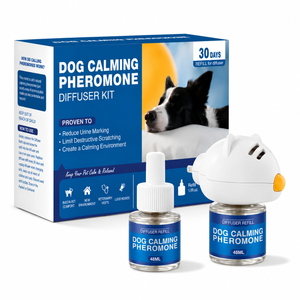
This is where a calming diffuser fits. Because it works on the whole room continuously, it’s already established before you leave rather than starting once you’ve gone.
Owners using our Dog Calming Diffuser Kit most often describe dogs settling faster after they leave, and less barking and pacing overall — modest changes rather than silence.
Set expectations properly: it’s a supporting layer, and it needs two to four weeks plus correct placement to be worth judging.

What not to do
When to get professional help
Speak to your vet or a qualified behaviorist if:
Genuine separation anxiety is a recognized behavioral condition. It’s treatable — but with a structured plan, sometimes alongside medication, not with products alone. Getting help early is far easier than after a year of practice.
Frequently asked questions
Exercise, calm departures and gradual alone-time do the work. A diffuser keeps the room steady while you’re out — and if your dog isn’t calmer in 30 days, you pay nothing.
Shop the Dog Calming Diffuser Kit →Related reading: 9 signs your dog is anxious · the complete guide to dog calming diffusers · comparing calming products
General information only, not veterinary advice. Please consult your vet or a qualified behaviorist for severe separation distress.