Diffuser vs Calming Treats vs Thundershirt vs Comfort Toys
Comparison•8 min read
There’s no single best calming product, because these four things solve different problems. Picking the wrong category is why so many owners conclude “none of it works.”
The short answer
Match the tool to the pattern. Diffusers for ongoing anxiety at home (slow, passive, whole room). Treats for short predictable events (fast, travels, check with your vet). Wraps for acute fear episodes. Toys for boredom, not fear. And nothing on this page beats training, routine, and enough exercise.
Here’s what each one is actually for.
Quick comparison
Diffuser
Best forOngoing anxiety at home
CoverageOne room, continuous
Speed2–4 weeks
EffortVery low
Calming treats
Best forShort, predictable events
CoverageThe dog, temporarily
Speed30–90 mins
EffortLow
Anxiety wrap
Best forAcute fear episodes
CoverageThe dog, while worn
SpeedAlmost immediate
EffortMedium
Comfort toy
Best forBoredom, company, chewing
CoverageThe dog, while used
SpeedImmediate
EffortLow
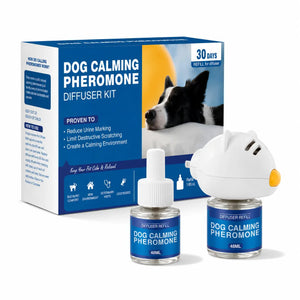
Calming diffusers
What it is: a plug-in releasing synthetic dog appeasing pheromone into a room, continuously.
Calming diffuser
Best for: ongoing, environmental, home-based anxiety. Being alone during the day, general restlessness, settling into a new home, a nervous rescue dog, low-level tension in a multi-dog household.
Strengths
✓Runs continuously without you doing anything
✓Covers all dogs in the room
✓Works while you’re out — precisely when many dogs struggle
✓Nothing to wear, swallow, or tolerate
Limitations
×Only affects the room it’s in
×Slow — weeks, not hours
×Effects are modest, and some dogs don’t respond
×Useless outside the home
Skip it if: your dog’s problem is on walks, at the vet, or in the car. Wrong tool.
Petstone Dog Calming Diffuser Kit
The low-effort layer for anxiety at home
Available in one, two, and three-room sets. Refills included, about 60 days each.
30-day money-back guarantee · Free shipping over $49
Calming treats and supplements
What it is: chews or powders with ingredients intended to reduce anxiety.
Calming treats & supplements
Best for: short, predictable events where you need something on a timescale of an hour — a car journey, a vet appointment, visitors arriving.
Strengths
✓Works within roughly 30–90 minutes
✓Travels with the dog anywhere
✓Easy to give as a one-off
Limitations
×Evidence quality varies enormously by ingredient
×Wears off in hours
×Requires the dog to eat it — many anxious dogs refuse food
×Interaction risk with medication
Important: check with your vet before giving supplements, particularly if your dog takes any medication or has a health condition. This is the one category where “natural” doesn’t mean “no interactions.”
Anxiety wraps and vests
What it is: a snug garment applying gentle constant pressure to the torso.
Anxiety wrap
Best for: acute, identifiable fear episodes — storms, fireworks, a specific known trigger.
Strengths
✓Can be put on immediately when needed
✓No ingestion, no chemicals
✓Goes anywhere
✓Reusable indefinitely
Limitations
×Evidence is limited and mixed
×Some dogs dislike wearing them, which adds stress
×Only works while worn — not for a full working day
×Needs correct fit and prior acclimatization
Tip: introduce it on calm days first. Putting an unfamiliar garment on a panicking dog for the first time during a thunderstorm usually backfires.
Comfort toys and chews
What it is: plush companions, chew toys, stuffable feeders.
Comfort toys & chews
Best for: boredom, mental occupation, something to do while alone, and giving anxious energy an outlet.
Strengths
✓Immediate
✓Genuinely enjoyable for the dog
✓Chewing and licking are naturally self-soothing
✓Cheap, and easy to rotate
Limitations
×Doesn’t address fear itself
×A frightened dog usually won’t engage with a toy
×Supervision needed with destructive chewers
The distinction that matters: toys are excellent for boredom and reasonable for comfort, but they don’t do much for fear. If your dog is destructive because they’re bored, a toy is the right answer and a diffuser isn’t.
Which should you choose?
Match the product to the pattern:
“They struggle when I’m at work all day”
Diffuser, plus a chew or feeder toy for occupation.
“They panic at fireworks and storms”
Diffuser started a week ahead, plus a wrap on the night, plus a safe room. Ask your vet about medication if the panic is severe.
“They’re fine at home but terrible in the car”
Treats or a spray. Diffusers don’t travel.
“They’re destructive when left alone”
First work out whether it’s boredom or distress. Boredom wants enrichment and exercise. Genuine distress wants a behaviorist.
Diffuser, more daytime exercise, and a consistent wind-down routine.
What outperforms all four
Training, routine, and adequate exercise have a stronger evidence base than any product on this page.
A predictable daily rhythm, enough physical and mental exercise, and gradual training for being alone will do more than anything you can buy.
These products are useful layers on top of that foundation. They’re poor substitutes for it.
Frequently asked questions
Can I use several of these together?
Yes, and for big events like fireworks it’s common to combine a diffuser, a wrap, and a safe room. Check with your vet before combining supplements with medication.
Which works fastest?
Treats (30–90 minutes) and wraps (almost immediate). Diffusers are the slowest at two to four weeks.
Which is best value long-term?
Diffusers, if your dog responds — continuous coverage, low ongoing cost. Treats add up if used daily.
Do any of these cure anxiety?
No. They reduce symptoms at best. Behavioral treatment addresses causes.
What about prescription medication?
Appropriate for moderate-to-severe cases and worth discussing with your vet. It’s often used alongside behavioral work rather than instead of it.
My dog didn’t respond to a diffuser. Will treats work?
Possibly — they work differently. But first check the diffuser was set up correctly, since most failures are setup errors.
For anxiety at home
The lowest-effort option on the list
Nothing to wear, nothing to remember, and it works while you’re out. Judge it after four weeks — if your dog isn’t calmer, you pay nothing.