



Setup & Placement•7 min read
Placement is the difference between a diffuser that works and one that gets returned. The product can be perfectly good and still do nothing if it’s behind a sofa, next to an open window, or in a room your dog barely enters.
Plug it into a low, open socket in the room your dog actually uses, at least a couple of yards from any window, vent, fan, or air purifier, near where they rest but never underneath bedding — and leave it running 24/7. Get those five things right and you’ve eliminated almost every reason a diffuser “doesn’t work.”
Here are the rules, in priority order.
The 7 rules
Put it in the room your dog actually uses
This is the one that matters most. A diffuser affects roughly the room it’s in — one main room per unit — and pheromone doesn’t travel through doorways, up stairs, or round corners.
Be honest about where your dog spends time. Not where you’d like them to be. If they sleep in the kitchen and you’ve plugged it into the living room, you’re treating an empty room.
Keep it completely unobstructed
Nothing in front of it, nothing over it, nothing pressed against it. Furniture blocks dispersal more than people expect — a diffuser behind a sofa is mostly treating the back of your sofa.
If you can see the unit from the middle of the room, it’s probably placed well.
Use a low socket
Lower sockets are better than high ones. Your dog lives at floor level, and starting the dispersal closer to their breathing height gives it a better path to them.
Baseboard height is ideal. Avoid counter-height sockets if you have a choice.
Keep it away from moving air
This is the second-biggest killer after wrong room. Anything that moves air out of the room takes the pheromone with it:
Aim for at least a couple of yards from any of these, on a wall that isn’t in the main draft path.
Position near where your dog rests — but not underneath
The bed or crate is the right area, since that’s where your dog settles. But don’t plug it in directly beneath bedding, blankets, or inside a covered crate. Blocking the unit stops dispersal and traps heat around an electrical device.
Nearby and open beats close and covered.
Leave it running continuously
Diffusers are designed to run 24/7. Unplugging at night or when you’re out drops the room concentration and restarts the build-up each time.
Continuous running is also what makes a diffuser suitable for separation-related behavior — the room needs to already be at a steady state before you leave, not warming up after you’ve gone.
Give it a fair trial before moving it
Once placed well, leave it alone for at least two weeks. Moving it every few days means it never establishes anywhere. See what to expect in your first 30 days.
The 5 places to avoid
A quick placement check
Stand in the doorway of the room and ask:
Four or five yeses means you’re set.
If your dog uses more than one room
You need a diffuser in each. This isn’t upselling — it’s how the coverage works. A dog who sleeps upstairs and lives downstairs is only being helped half the time with one unit.

Work out your number with our room-by-room guide.
Frequently asked questions
One low, open socket in your dog’s main room. Leave it running and judge it after four weeks — if your dog isn’t calmer, you pay nothing.
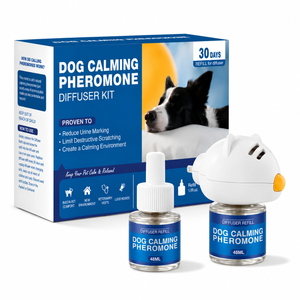
Shop the Dog Calming Diffuser Kit →New to diffusers? Start with the complete guide to dog calming diffusers, or check whether it’s safe around cats, kids and other pets.
General information only, not veterinary advice.