


The Evidence•10 min read•With sources
Short answer: sometimes, for some dogs, to a modest degree. The research is real but mixed, the effects reported are subtle rather than dramatic, and individual variation is large.
A 2010 systematic review found only one of seven dog studies had sufficient evidence.[1] A 2021 appraisal of eight controlled trials rated the overall evidence weak — but found moderate evidence specifically for thunderstorm noise.[2] So: worth trying for mild-to-moderate ongoing anxiety if you can accept a modest effect. Not worth trying if you need a guaranteed fix for severe distress.
We sell these, so you’re right to weigh what follows accordingly. But we’d rather you buy with accurate expectations than return it angry — so here’s the honest version, with every research claim cited at the bottom so you can check it yourself.
What the research base looks like
Dog appeasing pheromone has been studied in peer-reviewed veterinary research since the late 1990s, across shelters, veterinary clinics, noise phobia, car travel, and puppies adapting to new homes. Here’s what the two independent reviews concluded.
One of seven studies passed
A systematic review in the Journal of the American Veterinary Medical Association assessed prospective studies from 1998–2008. Of seven canine reports, one provided sufficient evidence — a collar reducing fear during training in puppies aged 12–15 weeks.[1][3] The other six were judged insufficient: noise phobia (two studies), travel problems, fear in the vet clinic, shelter stress, and vocalising and house-soiling in newly adopted puppies.[1]
Across cats and dogs together, 11 of the 14 reports reviewed provided insufficient evidence.[1]
Weak overall, moderate for storms
A later appraisal published by RCVS Knowledge looked at eight controlled trials in dogs over six months old — four randomised, four not clearly randomised. It rated the overall strength of evidence as weak, while finding moderate evidence that pheromone reduced some behavioural signs of fear from thunderstorm noise, and no evidence that any one format outperformed another.[2]
In other words: not nothing, and not what the marketing usually implies.
Individual trials with positive findings
A double-blinded, placebo-controlled study in the Canadian Veterinary Journal looked at dogs hospitalised for four or more days and reported statistically significant improvements in three of ten separation-related behaviours measured — elimination problems, excessive licking, and pacing.[4]
Others have examined shelter dogs[5], long-term kennelled dogs[6], and newly adopted puppies[7]. These appear in veterinary journals — they aren’t fringe studies.
It is not proven the way a vaccine is proven, and it is not baseless the way many pet products are. It sits in the awkward middle — a plausible intervention with genuine research behind it and genuinely inconsistent results.
Evidence strength, use by use
This is the most useful way to read the literature. Not does it work, but work for what — graded by what the 2021 appraisal actually found.[2]
The strongest single finding in the literature. Some behavioural signs of storm-related fear were reduced.
Reduced barking intensity and more behaviours associated with relaxation in shelter dogs.
Some non-specific stress behaviours in hospitalised patients improved.
The 2010 review found the studies in these areas didn’t support firm conclusions either way.
What this means practically: if your dog’s problem is noise-related fear at home, you’re in the best-supported use case there is. If your problem is car travel or vet visits, the evidence is genuinely thin — and a spray or a conversation with your vet may serve you better than a diffuser.
Why results vary so much between dogs
Individual response differs
Not every dog appears to respond, and there’s currently no way to predict in advance which will. This is the single biggest source of variation, and no product can engineer around it.
The cause of the anxiety matters
A diffuser addresses how safe a room feels. It does nothing about boredom, under-exercise, untrained behaviour, or pain — all of which look like anxiety from the outside.
Setup varies enormously
Wrong room, blocked placement, competing airflow, intermittent running, and empty refills account for a large share of “it didn’t work.” See six common mistakes.
Expectations vary
Someone expecting a dog to stop barking entirely will call a substantial reduction a failure. Someone tracking minutes will call the same result a success.
What “working” realistically looks like
Where diffusers are a poor choice
We’d genuinely rather you didn’t buy one if any of these apply.
Panic-level distress — self-injury, destroying doors, escaping — needs a qualified behaviourist and often veterinary support. A diffuser is not a treatment for that, and using one instead of getting help costs your dog months.
Sudden restlessness, night pacing, or new reactivity is frequently pain or illness. See a vet first.
No pheromone substitutes for a walk and something to do. This is the most common misdiagnosis we see.
It needs days to build and weeks to assess. There is no same-day version of this.
How to give it a fair test
If you do try one, run it as an actual test rather than a hope.
If you see nothing after four weeks of correct use, your dog is likely a non-responder. That’s a legitimate result, and knowing it beats another six months of hoping. Full week-by-week detail in your first 30 days.

How it compares to the alternatives
Every option has trade-offs, and none of them is a cure.
Full comparison in diffuser vs treats vs Thundershirt vs toys.
Our honest position: training and routine do the heavy lifting. A diffuser is a low-effort layer on top that helps some dogs somewhat. That’s a reasonable thing to buy — as long as that’s what you think you’re buying.
Frequently asked questions
Sources
Four weeks, right room, running continuously. That’s the only honest test there is — and if your dog isn’t calmer, you pay nothing.
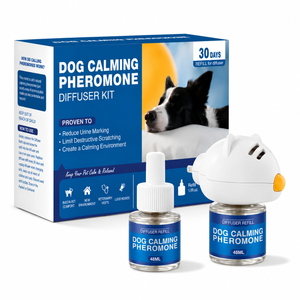
Shop the Dog Calming Diffuser Kit →Related reading: what are dog appeasing pheromones? · the complete guide to dog calming diffusers · why it isn’t working
General information only, not veterinary advice. For severe anxiety, please consult your vet or a qualified behaviourist.