


The Science•9 min read•With sources
Dog appeasing pheromone — usually shortened to DAP — is a chemical signal produced by nursing mother dogs. Synthetic versions of it are what’s inside calming diffusers, sprays, and collars.
DAP is secreted by a lactating dog from the skin between her mammary glands in the days after birth, and is detected by the vomeronasal organ — a separate structure from ordinary smell. It was identified and first synthesised in the late 1990s.[1] It is not a drug and isn’t systemically absorbed.[1] The published evidence is real but mixed and generally rated weak, with the strongest signal so far around thunderstorm noise.[2][3]
This post explains where it comes from, how it’s thought to work, and — importantly — where the science is solid and where it isn’t. Every claim about the research is cited at the bottom.
What is a pheromone?
A pheromone is a chemical signal released by an animal that affects the behaviour of others of the same species. That last part matters: pheromones are species-specific. A dog pheromone doesn’t affect cats, and neither affects humans.
This is different from a scent or fragrance. Pheromones aren’t detected as smells in the ordinary sense, and dog appeasing pheromone is odourless to people.
Where does dog appeasing pheromone come from?
It was identified in the secretions of the skin around the mammary area of nursing female dogs, and the natural form is produced from roughly three days after birth.[1][4] Puppies are exposed to it during the period when they’re most dependent and most in need of a signal that they’re safe.
The mechanics are more interesting than you’d expect. The compound becomes volatile in combination with bacteria naturally present on the skin, helped by the warmth of increased blood flow to the mammary area during lactation, and is released from the groove between the mammary glands directly into the air.[1][4]
The premise behind the products: that this signal doesn’t stop meaning something once a dog is weaned. The foundational literature reports calming effects in both young and adult dogs, and that the reassuring properties persist into adulthood.[1]
The synthetic version in commercial products is a manufactured analogue of that natural compound, first synthesised in the late 1990s.[4] Nothing is extracted from animals.
How is it detected?
Pheromone detection in dogs is attributed to the vomeronasal organ — a paired structure in the nasal cavity, separate from the main olfactory system that handles ordinary smell.[1][4] Proteins in the nasal mucus appear to be involved in taking the molecule up.[4]
Because it’s a separate pathway, a dog doesn’t experience it the way they experience the smell of dinner. And because humans lack a functional equivalent, we don’t detect it at all.
Worth being honest about: the neurological pathway from detection to calming effect is not fully understood.[4] One proposed explanation is that appeasing pheromones shift an animal towards a more optimistic emotional bias, so the environment feels less threatening — but that’s a working hypothesis, not established fact.
Is it a drug?
No, and this distinction matters. The literature notes that because DAP is not systemically absorbed, it has no reported toxicity or side effects, which is why it’s described as usable alone or alongside psychotropic medication.[1]
It doesn’t cause drowsiness or affect coordination.
It acts as a signal, not a systemic compound.[1]
A responsive dog looks like a slightly calmer version of themselves, not a different dog.
Not in the way pharmaceutical sedatives can.
That’s also why the realistic expectation is a modest shift in baseline, not a dramatic effect.
What the research actually shows
Here is where we’d rather be straight with you than oversell. There is genuine peer-reviewed research on DAP going back to the late 1990s, across shelters, veterinary clinics, noise phobia, travel, and puppies in new homes. The results are mixed, and the overall quality of evidence is limited.
Only one of seven dog studies had sufficient evidence
A systematic review in the Journal of the American Veterinary Medical Association assessed prospective studies published between 1998 and 2008. Of seven canine reports, one was judged to provide sufficient evidence — a DAP collar reducing fear or anxiety in puppies aged 12–15 weeks during training. The remaining six were judged insufficient, covering noise phobia, travel problems, fear in the veterinary clinic, shelter stress, and vocalising and house-soiling in newly adopted puppies.[2]
Across both cats and dogs, 11 of the 14 reports reviewed provided insufficient evidence.[2]
Weak overall — but moderate for thunderstorms
A more recent appraisal published by RCVS Knowledge looked at eight controlled trials in dogs over six months old and rated the overall strength of evidence as weak. Its specific findings were more nuanced:[3]
Half the trials were randomised; the other half were non-randomised or didn’t clearly describe how dogs were allocated.[3]
Some positive findings do exist
A double-blinded, placebo-controlled study in the Canadian Veterinary Journal looked at dogs hospitalised for four or more days and reported statistically significant improvements in three of ten separation-related behaviours measured: elimination problems, excessive licking, and pacing.[5]
Others have examined long-term kennelled dogs[6] and newly adopted puppies.[7] A placebo-controlled study in captive African wild dogs found appeasing pheromone prevented a stress-related hormonal surge, which is interesting mechanistically but a long way from your living room.[8]
A meaningful share of the foundational DAP research was carried out by researchers affiliated with pheromone manufacturers.[1] That doesn’t make the findings wrong, but it’s a reason to weight the independent systematic reviews more heavily — which is exactly why we’ve led with them here.
This is a plausible, researched intervention — not a folk remedy, and not a settled, proven treatment. Anyone telling you it’s definitively proven is overstating the evidence.
What that means for you:
We go into the practical side of this in do pheromone diffusers actually work?

How the product formats differ
The same active idea is delivered three ways, and format changes what it’s good for. Notably, no review has found one format superior to another[3] — so choose by situation, not by claimed strength.
Treat a whole room continuously. Best for ongoing, environmental anxiety — being home alone, general restlessness, settling into a new house.
Applied to bedding, a crate, or a car interior. Short-acting and targeted — useful for travel and vet trips.
Travel with the dog and work outside the home. Useful for walks and unfamiliar places, but limited to the dog’s immediate vicinity.
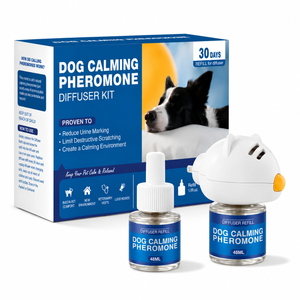
Most owners dealing with home-based anxiety start with a diffuser, since that’s the situation it fits best — which is what our Dog Calming Diffuser Kit is designed for.
What about cat pheromones?
Cats have their own separate products based on entirely different compounds — most commonly facial pheromones associated with territorial marking. They are not interchangeable.
A dog diffuser will do nothing for a cat, and a cat diffuser will do nothing for a dog. In a multi-pet household you’d need both if you wanted to address both animals — see our Cat Calming Diffuser Kit.
Frequently asked questions
Sources
Response varies between individuals, so four weeks of proper use tells you more than any study can. If your dog isn’t calmer, you pay nothing.
Shop the Dog Calming Diffuser Kit →Related reading: the complete guide to dog calming diffusers · is it safe? · comparing calming products
This article is general information, not veterinary advice. If your dog’s anxiety is severe, please speak to your vet or a qualified behaviourist.